Recycling should be more than setting up an activity for children or adding sustainability into our program occasionally.
It should be embedded into our everyday practices, decisions and routines.
Quality Area 3 of the National Quality Standard focuses on the physical environment.
Within this, Element 3.2.3 – Environmentally Responsible recognises that services care for the environment and support children to become environmentally responsible and show respect for the environment.
So where do we begin?
It Starts With You!
Before thinking about how to teach children about recycling and upcycling, let’s reflect on our own practices.
- Are we placing the correct items in the recycling bin?
- Are we following our local council’s recycling guidelines?
- Are we making thoughtful decisions about the resources we purchase and the waste we create?
- Are we considering what could be used or transformed before throwing it away?
Children learn from what they see us as adults/educators do. When educators consistently demonstrate environmentally responsible practices, sustainability becomes part of everyday life rather than just another planned activity.
How Can We Maximise Recycling?
We can look at this from two perspectives.
- How does the service manage its waste and make use of existing materials?
- How do educators involve children in sustainable practice?
The aim is not just to recycle more, but to prevent unnecessary waste in the first place.
How Does Your Service Manage its Waste?
Let’s start by looking at what your service throws away each day and identifying what is the biggest source of waste in your service.
A simple waste audit can help. Observe what is being discarded over a week, identify what could be reduced, reused, upcycled, or recycled. Now choose one improvement to trial.
🍽️ Food and Mealtimes
Are you noticing a lot of food being thrown away?
Consider offering appropriate portions and allowing children to request more. Review food preparation practices, meal timing and children’s preferences while respecting their hunger and fullness cues.
Where suitable systems are available, food scraps may also be composted. Check which scraps your composting system or collection service accepts. Ask your families/community if they can recycle food scraps for chicken food or home compost.
📜 Paper
Are children using large amounts of paper? Are we printing documents unnecessarily or could some information be shared and stored digitally?
Consider using both sides of paper, making suitable offcuts available for creative experiences and recycling clean, accepted paper when it is no longer needed.
Keep paper accessible for children’s meaningful drawing, writing and exploration while helping them learn to use resources thoughtfully.
🎨 Arts and Crafts
Are we thoughtful about the resources we purchase and how we use them?
Consider whether resources are durable, can be used in multiple ways and can support children’s play over time. Before buying new supplies, check what is already available.
Suitable fabric remnants, cardboard and other clean materials may offer opportunities for reuse or upcycling. An organised collection can help educators see what they have and avoid unnecessary purchases.
🎁 Packaging and Purchasing
Are supplies being ordered in ways that create unnecessary packaging?
Where practical, choose products with less packaging and purchase frequently used supplies in bulk when they can be stored and used without waste.
Before placing an order, ask: Do we need this? Could an existing resource serve the same purpose? Could something be repaired or repurposed?
🌱 Garden and Outdoor Areas
Are we using our outdoor spaces to support sustainable practices?
Consider composting suitable garden waste, growing herbs or vegetables and using available green waste collection services.
There may also be opportunities to upcycle suitable containers into planters or repurpose existing resources for garden use. Check their condition, previous contents and suitability before introducing them.
Check what your council accepts
Make sure your team know what belongs in each bin and which items need separate disposal as recycling guidelines and collection services vary.
A few helpful reminders:
- Empty containers before placing them in recycling.
- Keep recyclables loose rather than placing them in plastic bags.
- Keep food scraps and general rubbish out of recycling bins.
- Check whether items such as batteries and electronic waste require separate collection or drop-off.
- Ask your waste contractor whether contamination or collection arrangements could be improved.
For services in WA, visit Recycle Right WA to check local recycling guidance.
Involve the whole team & the children
Recycling and upcycling work best when everyone understands their role. Rather than leaving sustainability to one educator, make it a shared responsibility.
Discuss what your waste audit reveals, agree on a practical change and revisit it together. Has it reduced waste? Are the systems easy to follow? What needs adjusting?
How Can Educators Involve Children in Sustainable Practices?
Sustainability is not just about what goes into the bins. It is also about the habits, attitudes and understanding children develop through everyday practices.
Make Recycling Easy for Everyone
Recycling involves collecting and processing accepted waste materials so they can become new materials or products.
- Set up clearly labelled recycling stations with pictures of accepted items. The visual guides to help children understand where different materials belong.
- Position bins conveniently for educators and makes supported participation accessible to children.
- Invite children to participate in sorting clean, locally accepted recycled materials with educator support.
- Explore what happens to materials after they are collected.
Ask questions such as: “What is this made from?” “How could we find out where it belongs?” “What might it become after recycling?”
Make Sustainability Part of Everyday Routines
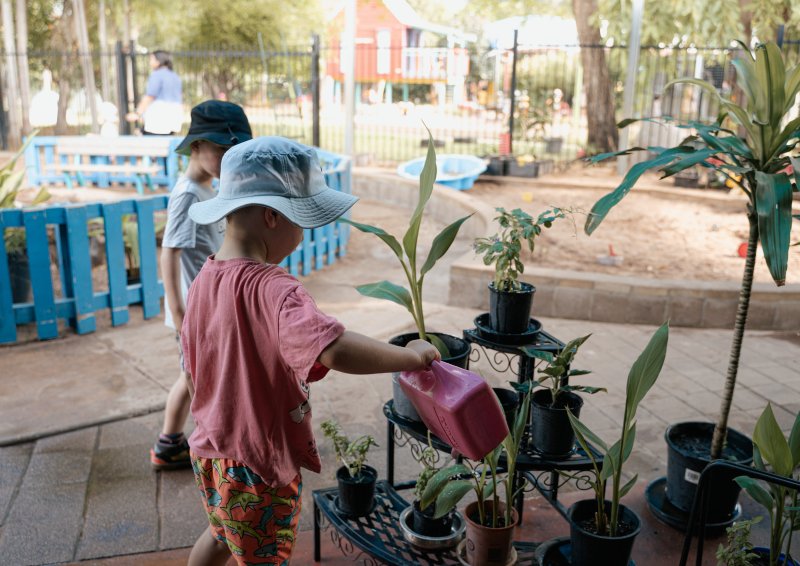
Invite children to help care for gardens, look after shared resources and discuss waste during meals, play and creative experiences.
Explain your own decisions in simple language: “We can use the other side of this paper,” or “Let’s see whether we can repair this before replacing it.”
These small conversations help children connect everyday actions with caring for the environment.
Reuse Materials Before Buying New Resources
Before purchasing something new, consider what is already available.
Clean cardboard boxes, paper, fabric offcuts and other suitable materials can provide opportunities for construction, imaginative play and creative exploration.
A box may be used repeatedly for building, transporting resources or pretend play without needing to be altered.
Establish an organised collection of safe, clean reusable materials that educators and children can draw on. Regularly review it, so the collection remains useful and manageable.
Explore Upcycling: Giving Materials a New Purpose
Upcycling involves transforming an unwanted item into something useful or of greater value.
With children’s ideas and appropriate educator support, you might:
- Transform a sturdy cardboard box into a puppet theatre for ongoing storytelling.
- Turn suitable fabric offcuts into reusable bunting for service celebrations.
- Repurpose suitable containers into planters for a herb garden.
- Transform an old adult shirt into a painting smock by adapting it for safe, comfortable use.
Involve children in planning, creating and evaluating the result.
“What could this become?”
“What would we need to change?”
“How could we make it last?”
Always consider children’s ages, hygiene, choking hazards, sharp edges and the suitability of materials. Adults should complete any preparation requiring tools or other potentially hazardous processes.
Think Beyond the Bin – But Think About What Happens Next
Reusing and upcycling materials can create valuable opportunities for learning. However, transforming an item does not automatically make it more sustainable.
Combining recyclable materials with glue, glitter, plastic decorations or other difficult-to-separate materials may make them harder to recycle later.
Before transforming something, ask:
- Can we reuse it without changing it?
- Will the finished creation have an ongoing purpose?
- Can its materials be separated and recycled afterwards?
- Is it safe and suitable for the children using it?
- Could we achieve the same experience with less waste?
The goal is to make thoughtful choices about what we keep, how we use it and what happens when it is no longer needed.
Small Changes, Big Impact
Sustainability becomes embedded through everyday practices, ongoing reflection and connections with families and the community.
It is not about getting everything right overnight. It is about noticing opportunities, making thoughtful changes and involving children in the process.
This National Recycling Week, Start Small.
Look at your bins, review your purchasing habits, involve your team and explore an opportunity to reuse or upcycle something already available.
Choose one change, give it a purpose and see where it leads.
Because small, consistent changes can make a meaningful difference to how our services care for the environment – and how children learn to care for it, too.
Find out more at: National Recycling Week