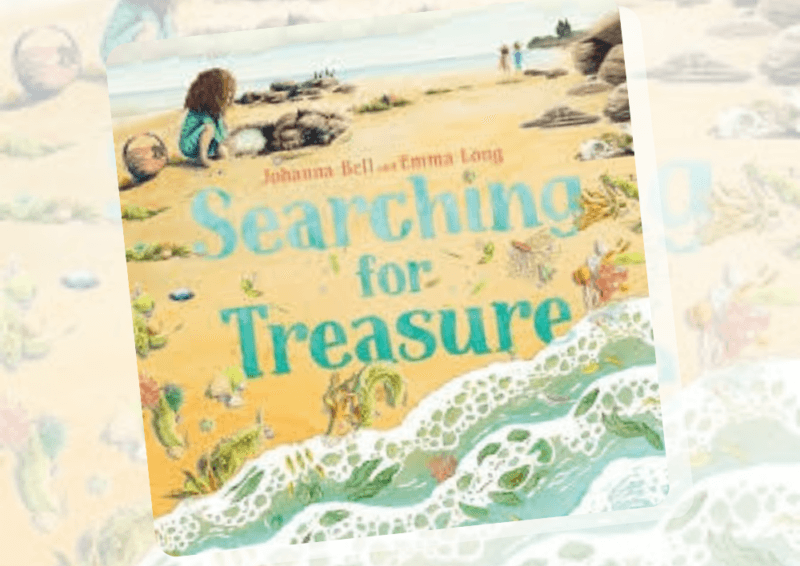
“Searching for Treasure”
 Join a family on a treasure hunt along the high tide line of a beautiful Australian beach. With each step, the child explores the shoreline, discovering fascinating sea treasures left behind by the ocean.
Every page invites readers to look closely, wonder and imagine what might be found next.
What has the sea washed up? Can you find its hidden treasures?
- Title: “Searching for Treasure“
- Written by: Johanna Bell
- Illustrated by: Emma Long
- Age Group: 3 – 6 years
- Links to EYLF ⤵️
| Principles | Practices | Learning Outcomes |
|---|---|---|
| PrinciplesSecure, Respectful and Reciprocal Relationships | PracticesPlay-based Learning and Intentionality | Learning OutcomesOutcome 4: Children are confident and involved learners |
| PrinciplesSustainability | PracticesHolistic, Integrated and Interconnected Approaches | Learning OutcomesOutcome 2: Children are connected with and contribute to their world |
About the Book
From sea urchins and shark eggs to ghost crabs, cuttlefish, limpets and barnacles, every page is filled with wondrous coastal discoveries. The treasures extend beyond the stunning illustrations, encouraging readers to search for hidden text woven throughout the images. As they explore, children can uncover interesting facts and learn more about the incredible plants and animals that call Australia’s oceans and coastlines home.
Celebrating the joy of exploration and the art of noticing, this story encourages children to become absorbed in the small details of the natural world. Along the way, it highlights the natural cycles that shape coastal ecosystems, including tides, weather, life, death and renewal.
Rich in detail and wonder, this delightful book invites readers to revisit its pages, linger over the illustrations and engage in meaningful conversations again and again.
Why We Love It
Searching for Treasure is a beautifully illustrated book that is a delight to share with children. This book is very much about the journey rather than the destination, encouraging readers to slow down, look closely and discover hidden treasures nestled amongst the illustrations. The careful attention to detail supports a slow pedagogy approach, encouraging children to linger, wonder and explore.
The rhyming text and counting elements make this a fantastic book to revisit again and again, supporting both phonological awareness and early numeracy.
One of our favourite features are the hidden words woven throughout the illustrations. Tracing them with a finger as you read aloud helps children notice that print carries meaning.
The clever cut pages become longer and larger as the story unfolds, drawing readers deeper into the exploration. Each new treasure sparks more wonder until the magnificent fold-out page reveals what a child’s imagination has created from the treasures discovered along the way.
We also love the nonfiction elements sprinkled throughout the book. These fascinating facts often answer children’s questions as they explore the illustrations, building knowledge about the world around them. Rich coastal vocabulary provides opportunities to explore unfamiliar words together, making every reading a chance to learn something new.
This is a wonderful book to read, talk, sing, draw and play with children as you discover hidden treasures, wonder together and follow children’s curiosity.
Read
As you read Searching for Treasure together, follow the child’s interests as you explore the pages. Take your time, stop to investigate objects that capture children’s attention, and extend the learning with nonfiction books about the ocean, beaches and sea creatures.
Talk
Talk about what you notice in the illustrations. Ask open-ended questions such as:
- What can you see?
- What do you think this object might be?
- How do you think it got there?
These conversations help develop vocabulary, imagination and critical thinking skills.
Sing
There are lots of wonderful ocean-themed songs to share alongside this book. Try singing Five Little Seashells to reinforce counting, rhyme and rhythm.
Five little seashells lying on the shore,
Swish went the wave, and then there were four.
Four little seashells looking out at me,
Swish went the wave, and then there were three.
Three little seashells, quiet as can be,
Swish went the wave, and then there were two.
Two little seashells shining in the sun,
Swish went the wave, and then there was one.
One little seashell left all alone,
I picked it up and took it safely home.
Draw
What could you create from treasures washed up by the sea? Invite children to draw, paint or collage using shells, feathers, seaweed and other treasures from the book. Encourage them to use their imagination and transform their collection into something extraordinary.
Play
Hide shells, natural materials or picture cards in a sand tray, sensory tub or outdoor space and encourage children to search for and collect treasures. Talk about what they find, sort treasures into groups, count them, compare them and create displays.
Searching for Treasure is a wonderful book to help you slow down and implement a slow pedagogy approach for your 3–6-year-olds. Enjoy!