Children’s Book Recommendation
“Azumi, Theo, Bree and Jack lived side-by-side and back-to-back. “
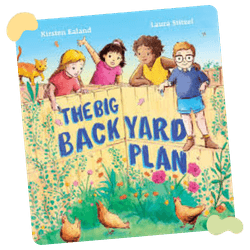
Being best friends as well as neighbours is fun. This group of four friends live side-by-side and back-to-back. Their houses are all tucked together in the neighbourhood. The children play together all the time. There is a pool, a vegie patch, a place to learn how to skate and a chicken pen with hens. The children love their homes, they love their friends’ homes because there is so many different games to play, adventures to share and fun to enjoy in every single backyard!
But there is a problem! It’s a long walk around the block to each other’s house. The children come up with one amazing idea. Imagine if instead of sharing backyard fences, they could share one BIG backyard? Together, they come up with a plan of how this could work. Could they convince all the parents, that fences are in the way? Could they convince their parents to get rid of the fences?
- Title: “The Big Backyard Plan“
- Written by: Kirsten Ealand
- Illustrated by: Laura Stitzel
- Age Group: 0-5 years
- Recommended by: Child Education Services
- Links to EYLF ⤵️
| Principles | Practices | Learning Outcomes |
|---|---|---|
| PrinciplesPrinciple 2: Partnerships | PracticesHolistic, integrated and interconnected approaches | Learning OutcomesOutcome 2: Children are connected with and contribute to their world. |
| PrinciplesPrinciple 3: Respect for Diversity | PracticesPlay-based learning and intentionality | Learning OutcomesOutcome 5: Children are effective communicators. |
About the Book
With lots of careful thought, the children collect all the reasons that one BIG backyard would be better. Then the four children boldly explain to their parents all the benefits of their plan. Helping to harvest home-grown veggies, sharing gardening tools, creating space that will attract all the insects, native birds and frogs needed to make a health environment.
How will the parents respond?
Will the children’s problem be solved?
Will their amazing solution be accepted?
Why We Love It
This one book is a joyful picture book about big dreams, best friends and removing the things that divide us.
It contains so many beautiful elements about play, environment, family culture, sharing resources, exploring with friends, working with neighbours, creating a plan and being bold enough to ask for more.
It wraps it all up together within a framework of rhyme and beautiful artwork.
The Big Backyard Plan uses playful rhyming text to engage young readers and support early language development. The consistent rhythm and rhyme create a musical quality that helps children anticipate words, build phonological awareness, and develop an enjoyment of stories (aligned with EYLF Outcome 5: Children are effective communicators). The repetition also supports memory and participation, inviting children to join in.
The artwork is vibrant, detailed, and nature-focused, extending the narrative for the visual learners. Illustrations of animals, plants, and outdoor spaces prompt observation and inquiry, supporting children to make connections between the story and the natural world (Outcome 2: Children are connected with and contribute to their world). The expressive characters and rich outdoor scenes also foster imagination and creative thinking.
Older learners might be fascinated in watching the artistic creation process used by illustrator Laura Stitzel.
Educator Book Recommendation
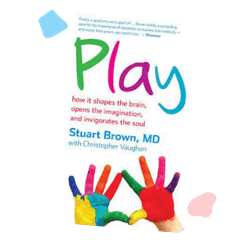
Explore the vital role of play in human development, wellbeing and lifelong learning.
Drawing on neuroscience, psychology and real-life case studies, Brown argues that play is not a luxury or a childhood activity left behind in adulthood, but a biological necessity that shapes the brain and supports healthy, adaptive functioning throughout life.
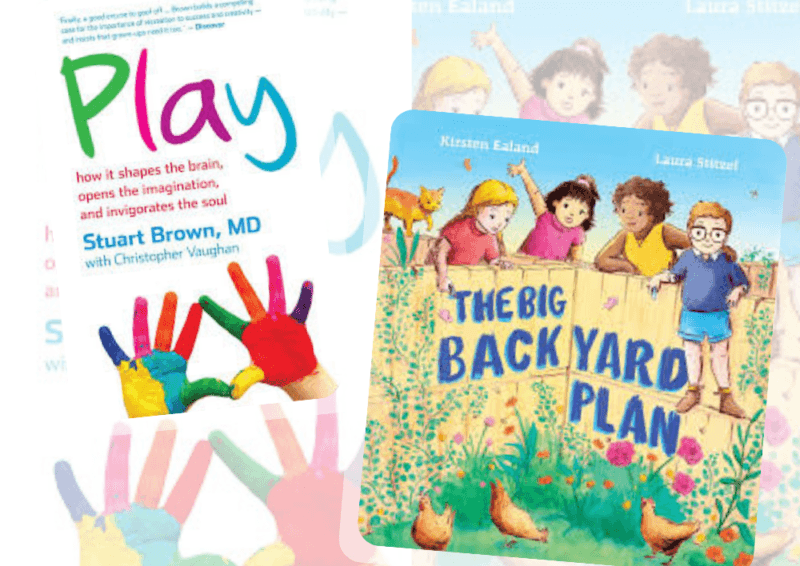
- Title: “Play: How It Shapes the Brain, Opens the Imagination, and Invigorates the Soul“
- Written & Illustrated by: Dr Stuart Brown MD with Christopher Vaughan
- Age Group: Educators
About the Book
The book begins by defining play as a natural, voluntary and pleasurable activity that is intrinsically motivated. It is done for its own sake rather than for an external reward.
Brown highlights that play takes many forms, from physical play and social play to imaginative, creative and exploratory play. Through his research, he introduces the idea that individuals have “play personalities,” meaning people are naturally drawn to different types of play experiences, such as storytelling, movement, competition or creative expression.
A central theme of the book is the strong connection between play and brain development. Brown explains that play:
- stimulates neural growth
- enhances flexibility in thinking
- supports problem-solving
- supports emotional regulation.
He demonstrates how play deprivation – particularly in childhood but also across the lifespan can negatively impact:
- social skills
- resilience
- lead to increased aggression
- increased rigidity in behaviour.
In contrast, regular engagement in play fosters adaptability, empathy, and creativity.
Brown also explores the role of play in relationships and social connection.
He shows how shared play experiences, such as humour, games or collaborative activities, build trust and strengthen bonds between people.
In adult life, play continues to support partnership, teamwork and communication by creating a sense of ease and openness.
Importantly, the book challenges the common perception that play is unproductive.
Brown argues that workplaces, education systems, and communities that embrace play enhance innovation and engagement (think of Google and Apple workplaces). He provides examples from industries that intentionally incorporate playful thinking to stimulate creativity and problem-solving.
Throughout the book, Brown encourages readers to reconnect with their own play history – reflecting on what brought them joy as children. Intentionally reintroduce play into daily life. He suggests that doing so can lead to greater fulfilment, improved mental health, and a renewed sense of curiosity and vitality.
Overall, the book presents play as a powerful, essential force that enriches both individual lives and society, positioning it as a foundation for learning, resilience and human connection across the lifespan.
Why We Love It
As Educators, we have the great joy of interacting with children on a daily basis.
Children play without feeling guilty and without fear of failing or wasting time.
Let’s take moment to learn from them and improve our own everyday wellbeing.
This book presents the neuroscience and social/cultural benefits behind the concept of Play as a necessary part of adult life. We are given permission to embrace play as a way to enhance our overall capacity as functioning adults.
As an adult, we are encouraged constantly to manage our lives, so we are healthier and happier. Eat healthy, exercise regularly, limit our screen time… When was the last time you set out to ‘Play’?
- Consider this:
- The next time you set up a Play activity for the children in your Service. Take the opportunity to not only observe the play around you, but to join the play as well.
- Allow yourself to join in with the activity – embrace your inner child and Play!
The benefits can be amazing! Not only can you build relationships with the children you care for and strengthen trust, but you exercise your own flexibility and adaptability skills.
You gain from that time of relaxation, tapping into the creativity that comes from shared play.
They say that if you find a ‘job you love, you’ll never work a day in your life’. Perhaps the key to balance out the ‘responsibility’ of being an Educator is to join in actual play!