Start with the Big Question: What Does Safety Mean?
Ok – take a breath, close your eyes and just for a second, pretend you’re an alien from out of space. You can see our whole world. You can see all the stuff going on in it. All the stuff – the good stuff and the bad stuff. Would you see a safe world?
Big question, right? What is safe? What do we mean when we say, ‘Be safe’. Whose responsibility is ‘safety’?
I like that question – ‘Who’s responsibility is safety?’
Safety Is Everyone’s Responsibility — Including Mine
Everyone! Everyone is responsible for safety. But ‘who’ is everyone?
I am. So the answer to the question ‘Who’s responsible for safety?’ has to be ‘me’.
I am responsible for safety.
But here’s another question: Whose safety am I responsible for?
My safety. My family’s safety. My team mates at work.
Early Childhood Educators Are Safety Professionals
But you’re an Early Childhood Educator, right? So, your responsibility for ‘safety’ is your job!
In fact, your work puts you at the centre of one of the biggest safety systems in Australia.
Every day, Early Childhood Educators help keep children safe while families work, study, attend appointments, care for others, and participate in community life.
It is easy for the broader community to talk about early education and care as if it is only about learning outcomes, routines, fees and staffing ratios. But underneath all of that sits something more fundamental: children need to be safe before they can learn, play, belong, explore or grow.
According to the Australian Government Department of Education, 1,491,460 children attended a Child Care Subsidy-approved service in the June quarter 2025. That includes children in centre-based day care and family day care, as well as other approved care settings. So, when we say that Early Childhood Educators keep Australians safe, we are not using a small idea. We are talking about up to 1.5 million children whose days are shaped by educators noticing, listening, responding, documenting, comforting, planning and acting.
That is a huge responsibility. It is also a human one. Safety is not only a checklist on a wall, a policy in a folder, or a training module we complete once and file away.
Safety is the moment an educator…
- scans the outdoor space and notices a gate latch has not clicked
- pauses before lifting a child
- decides to ask for help when a room feels stretched
- courageously speaks up when something does not feel right
- maintains their professionalism to follow through even when the day is busy.
We Can’t Keep Others Safe Unless We Are Safe Ourselves
We Can’t Keep Others Safe Unless We Are Safe Ourselves
Because safety is contagious. When educators feel safe to ask questions, report concerns, admit uncertainty and seek support, the whole service becomes safer.
When educators are rushed, unsupported, exhausted or afraid to speak up, risk can hide in plain sight. A safe culture is not created by perfect people. It is created by people who are encouraged to notice, communicate and act before harm occurs.
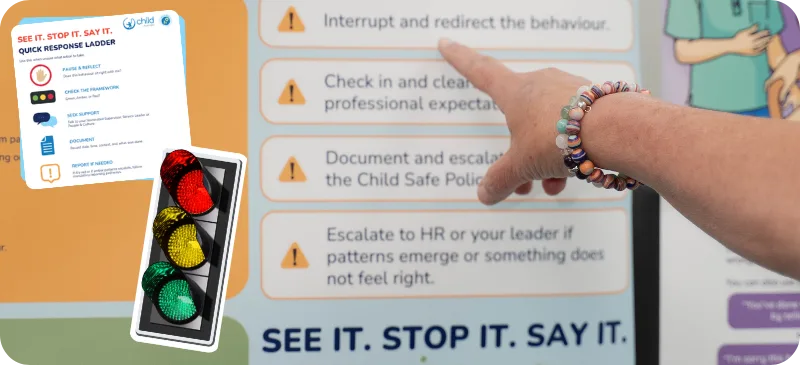
See It. Stop It. Say It. Adult Behaviour Traffic Light Framework
This is where the idea of “See it. Stop it. Say it.” becomes powerful. It is simple, but it is not simplistic.
“See it” means paying attention to adult behaviours in your environment, to behaviours during routines, to repeated behaviour patterns, and to the quiet signals that something may not be right.
“Stop it” means taking immediate action when there is a behaviour that is not right. Interrupt the unsafe behaviour or make note and seek help from your Room Leader.
“Say it” means immediate reporting, recording, sharing and escalating concerns so that safety does not depend on one person holding information in their head.
Six Everyday Habits That Protect Children and Teams
A practical way to remember this is through the word SAFETY:
Spot hazards early
Act promptly and appropriately
Follow procedures and policies
Educate yourself and others
Tell someone when something is unsafe
Yield to safe practices/policies before convenience.
Safety is a professional habit. Safety isn’t one dramatic action – it’s a hundred small choices made throughout the day.
Spot hazards early. That may be the cracked toy, the wet floor, the unsettled child, the missing medication form, the outdoor blind spot, or the educator who looks like they are carrying too much.
Act promptly and appropriately. Do not wait for a perfect moment if a child, colleague or visitor may be at risk.
Follow procedures and policies, because they exist to give everyone a shared standard when decisions need to be made quickly and consistently.
Educate yourself and others. Safety knowledge changes over time, and confidence grows when teams keep learning together.
Tell someone when something is unsafe. Silence is rarely neutral in a safety culture; if we see something and say nothing, the risk remains. Yield to safe practices before convenience. This can be hard in early childhood settings because the day is full, transitions are busy, and educators are constantly balancing competing needs. But the faster option is not always the safer option.
Recognising the People Who Do the Safety Work
This is also why Early Childhood Educators Day 3rd September matters.
It gives us a moment to recognise the people behind the practice. Jobs and Skills Australia report around 138,800 Early Childhood Educators and Room Leaders, with a workforce that is mostly part time and overwhelmingly female. But, behind that statistic are people who bend, lift, comfort, problem-solve, communicate, regulate emotions, hold professional boundaries, and notice the details that others may never see.
Be Safe. Take Care. Safety is Care!
So, when we say “Be Safe. Take Care.” We’re not just offering a nice sign-off. We’re naming a responsibility and a relationship.
- Be safe in your body, your workplace, your judgement and your team culture.
- Take care of the children in front of you, the colleagues beside you, the families who trust you, and yourself.
Because in early childhood education and care, safety is not separate from care. Safety is care.
- If you see something unsafe, stop and respond.
- If you’re unsure, say something.
- If you need help, ask.
- If a process is not working, speak up.
- And if you are the person other people come to, listen carefully.
A safer sector is built one action, one conversation and one decision at a time.
Safety is Everyone’s Responsibility!
It’s no surprise that Early Childhood Educators Day begins the National Child Protection Week (6-12 Sept) which asks the community to think about how every child can grow up safe and supported. While Bravehearts Day 11 Sep, raises awareness about child sexual abuse, encourage community action, support survivors, and promote child-safe environments. Safety for our children – our future leaders is a necessity. It’s everyone’s responsibility.
Early childhood services are part of that answer, but educators cannot carry this responsibility alone. Safety depends on leaders who listen, systems that work, teams that trust one another, and communities that value the people doing the work. It depends on professional learning that is practical, current and connected to real everyday decisions.
Early Childhood Educators are doing safety work every day, often quietly and often without fanfare. They are not only supporting learning; they are protecting wellbeing, strengthening trust and helping children experience the world as a place where adults notice, respond and care. That is worth recognising. That is worth investing in. And that is worth practising, every single day.
Thank you and take care!