For many non-Indigenous Australians, it is understood ‘why’ reconciliation is important. It is the only way we, as Australians, can move forward truthfully. But how do we embed that understanding in our hearts so it’s personal?
National Reconciliation Week reminds us to embrace our nation’s history, so we’re smarter and stronger for our future. We are invited to focus on building respectful relationships with our Aboriginal and Torres Strait Islander peoples. That’s big. How can I break it down to smaller steps, so I can learn and then apply them to my life – with my family, in my workplace and my community?
Start with the Facts & Ask Questions of Yourself
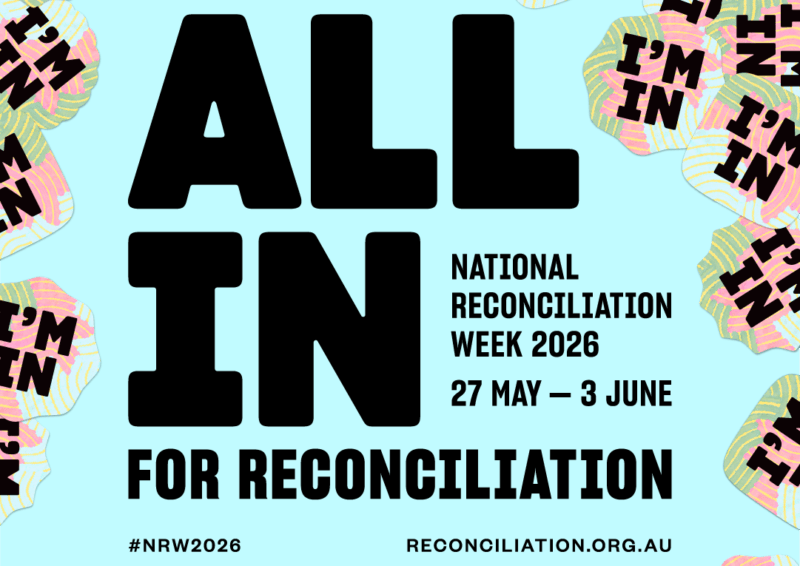
Fact: National Reconciliation Week (NRW) held from May 27-3 June each year.
- 27 May 1967 a referendum was held to change the Australian Constitution so that the Australian Government could make specific laws that applied to Aboriginal and Torres Strait Islander peoples that could assist in addressing inequalities. Learn more here.
- 3 June is Mabo Day is a celebration of the successful effort by Mer Island man Eddie Koiki Mabo to overturn the legal ‘fiction’ of ‘terra nullis’ or ‘empty land’. Eddie Mabo challenged the Australian Government in the High Court to recognise the Traditional Ownership of Aboriginal and Torres Strait Islander Peoples and won. This legal decision recognised First Nations people’s ownership of and unique connections to Land. Learn more here.
Ask Yourself:
🔵 Is there more information I can find about this?
Fact: Every year, National Reconciliation Week has a theme. This year’s theme is “All In”.
Reconciliation Week is a celebration every year.
Did you realise that the word ‘Reconciliation’ is a noun. It is the name for the process we take to restore relationships, harmony or understanding.
As Educators and Leaders in the Early Childhood Sector, our daily practice must include truthful, thoughtful and respectful actions to celebrate and better understand the Aboriginal and Torres Strait Islander point of view. You cannot achieve this unless you make it personal.
Take small steps, or big steps but make them regular steps. Change your mindset. View your role as an Educator through a different lens. You can be a learner and an educator at the same time. Make a personal agreement to do the research, so you step out with confidence.
Next year when Reconciliation Week rolls around, you will be able to celebrate the actions you’ve taken every day. So today is a good day to start!
Ask Yourself:
🔵 What does being “All In” mean to you as an Educator?
Fact: Each year there is an Artwork to inspire us in new ways.
🎨 2026 NRW Artwork – The 2026 National Reconciliation Week artwork is called Gaagal.
It is created by Gumbaynggirr Bundjalung artist Otis Hope Carey. He explains its inspiration and significance: “All of my paintings connect to water. This artwork uses the ocean as a metaphor for people from all walks of life swirling together to be ‘all in’ for reconciliation.”
Learn more about the artist and his artwork here.
Ask Yourself:
🔵 How do I connect with this artwork?
Now you have connected with this artwork, think about ways you can bring that sense of ‘understanding’ into your daily practice.
- Is there a way of introducing this painting to the children in your care?
- Are you able to show a colleague and discuss ‘what it meant to you’?
- Perhaps you have colleagues who are new Australians, who might like to learn more about First Nations art. Can you help explore the topic together, along with the children in your room?
Sometimes we can respond with our own art. Sometimes our response might take us on another kind of journey to discover other connections.
Fact: Each year there is a song claimed for National Reconciliation Week.
🎶 2026 NRW Song – Beds Are Burning by Midnight Oil.
Extra Fact: Did you know that each year over 400 choirs raise their voices to help us embed reconciliation in every day?
This year’s Voices for Reconciliation song Beds are Burning confronts the unresolved issue at the heart of Reconciliation – who owns the land, what justice looks like, who must take responsibility? Listen to the song here.
Ask Yourself:
🔵 What does this song mean to me?
Now you’ve connected with the song, think about ways you can introduce it to the children in your care.
Could you start a choir? Tune and beat are fantastic ways of initiating connection and interest. Words can be fantastic connectors for previous experiences.
Be agile, flexible and adaptable in your thinking and let the children create the path you can follow.
Fact: The land you live on has a First Nations History.
The land you live on, walk your dog on, ride your bike on, play sport on, work on has a First Nations history.
Look at your neighbourhood, the native animals, birds, insects, plants, trees, creeks, hills and stars through the lens of the local indigenous mob.
Ask Yourself:
🔵 Do I know the name of my local Aboriginal and Torres Strait Islander peoples?
🔵 Do I know the indigenous name for the native animals / insects I see?
🔵 Can I find out the indigenous name of the local river?
🔵 What are the indigenous names for the seasons?
Now you’ve found some answers for your local area, make sure to share them with your own family.
Then take the knowledge to your Service. Be excited by everything new you’ve learned. It is infectious for our colleagues and the children in our care.
As educators, we model how to learn. When we show children that we are excited by new information and are curious to know more about a new topic – we are good role models for them. Be sure to take the extra step and keep the knowledge as part of your daily practice.
Remember, every small effort you make, every new thing you learn makes it part of your story.
When it’s personal, it’s part of your everyday journey and makes reconciliation an action every day.