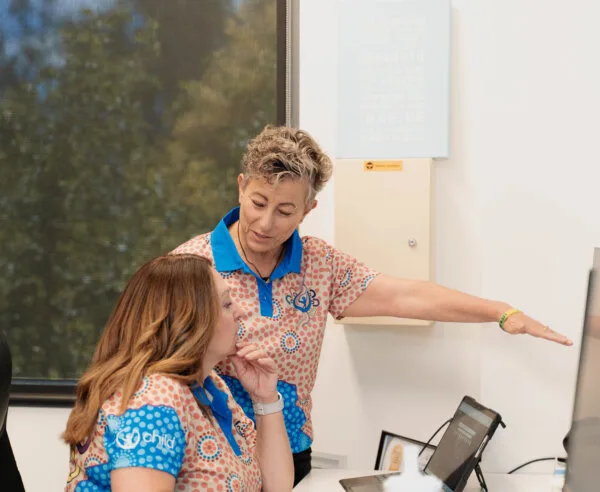

Being a neurodivergent individual can mean facing challenging hardships when navigating through life. However, once you have found your groove, your strategies and your way of managing life – your strengths and superpowers can truly shine.
Now, being a neurodivergent educator adds another layer because not only are you navigating and regulating your own emotions, but you are also supporting children, families and team members throughout your day.
Did you know?
Many neurodivergent individuals thrive within the education sector.
Educators who are neurodivergent can often bring creativity, problem-solving skills, innovation in programming and strong relationship-building strengths to their practice.
The challenge is often not ability but ensuring that through creativity, hard work and passion, we avoid burnout.
Working alongside neurodivergent and neurotypical colleagues requires understanding, curiosity and mutual respect. When we value different ways of thinking and working, team culture and practice can improve for everyone.
Masking and Wellbeing
What is Masking?
Masking is something many neurodivergent individuals experience. It involves suppressing natural behaviours to fit social expectations, which can be emotionally exhausting over time.
It is okay to have an off day. It is okay to not feel “perfect.”
Try identifying and naming how you feel:
“I am tired today, and that is okay”
“I am feeling overwhelmed, and I will work through this slowly”
Your Biggest Professional Strengths
Neurodivergent educators often demonstrate strength in:
- Innovation in programming
- Creative problem solving
- Relationship building and empathy
- Systems thinking and reflection
- Long-term thinking
Whilst there is no one-size-fits-all approach to neuroinclusion, intentional leadership, supportive environments and clear communication can improve wellbeing, team culture and quality educational practice.
Neuroinclusive environments also support high-quality childhood practice, where educator wellbeing directly influences responsive relationships with children and families.
1. Managing Tasks and Time
Managing tasks and time is something many of us struggle with. We can get so lost in tasks… either struggling to start them, struggling to step away from them (hello hyperfocus) or starting multiple things and not quite finishing any of them.
Managing tasks is something which is also so often misunderstood amongst neurodivergent individuals. It is not that you are lazy or unable to be organised. You just have not found your system or maybe you don’t know why you struggle. Let’s unpack this:
What are some common factors neurodivergent people face with time management and managing tasks?
- It is time to begin a specific task and this feels difficult.
- Hyperfocus makes it challenging to stop tasks.
You’ve run out of time and now you’re late for the next task.
Or maybe you have hyperfocused on a new idea within the task and gone off plan? None of these are bad things.
They are great. This is your creativity! - Multiple tasks feel overwhelming and you just don’t know where to begin.
- This may be familiar to a lot of you – finishing a task which was already started by you (& guilty because this was me with this write up).
- Or better yet, completing a task begun by someone else.
Sometimes starting multiple tasks at once provides temporary relief from pressure. However, this can lead to unfinished work and increased stress when deadlines approach.
In addition to that, an important fact to note: Neurodivergent individuals often work using interest-based motivation, meaning more interesting tasks may naturally be completed first.
Here’s something you also might not have thought about: When a neurodivergent person is starting a task they’ve never done before, especially if it’s something that will be repeated, it can feel overwhelming because it means creating a whole new system. And that alone can feel like a task in itself!
Or for some of you, it’s not even about the task itself, it’s that it doesn’t align with how you would usually approach things, so it’s hard to know how to work with it or where to begin.
What are practical strategies to overcome the challenges?
- Find a planning system that works for you
You know the “planner phase” buying all the things, trying to make it look perfect? Some of you may already have a system and that’s okay.
Just remember, your system doesn’t need to work for every situation. Sometimes we fixate on one method and don’t realise it’s not working in a different context. - Identify your comprehension style
- Are you a visual learner?
- Do you prefer written lists?
- Does a digital planner suit best?
- Or maybe using tools like Microsoft To-Do, calendars or a paper planner can support organisation.
- Once you have identified this, you can implement that planner i.e. the wall planner (visual), the paper ‘to-do list’ or having a diary.
- Plan your day before taking on more
When working on the floor or with your team, take a moment to:- Write a clear list of what you need to do.
- Review your current tasks before accepting new ones.
- Prioritise what actually needs to be done first.
- Work together
Ask a colleague to help you map out priorities or be that person for someone else.
Shared planning can reduce overwhelm and create clarity.
Supporting task management is not about doing more—it is about working in ways that actually support how your brain functions.
2. Navigating the “Rabbit Holes” & Perfectionism
I cannot tell you how many times I was meant to do a simple task, and all of a sudden I am adding more aspects, creating a foundation for it, and then going back and forth. Next thing you know I am in a rabbit hole.
Many neurodivergent thinkers experience deep focus, which can sometimes lead to overworking tasks beyond what is required.
It is important to identify when you are going down a rabbit hole. Start by saying out loud to yourself:
“I am going down a rabbit hole.” – (Like me with this write up but in this instance, it was necessary as I want to get this message across).
Once you identify, relook at what the task was set out to be and see if you are going sideways. Bring yourself back to what you need to do.
This is not about suppressing creativity, it’s about reminding yourself that not all tasks need perfection. Sometimes perfectionism impacts practicality, and with many things to do daily, it can affect productivity.
Bring it back and ask yourself:
- Is this what was asked of me?
- Does adding more make a meaningful difference?
Another helpful strategy/resource – Using a timer for various reasons:
- Use the timer to see how long a task takes.
- Set the timer for future tasks to maintain the nominal task time.
- Set the timer to go off every 30 – 60 mins help you know where you are at. Kind of like a visual tracker.
All of the above helps when ‘time blindness’ kicks in. Time blindness is a real thing that appears when deeply focused. Timers help bring awareness back tothat time is passing.
3. Identifying Your Needs and Asking for Adjustments
If instructions, resources or processes feel overwhelming, unclear or don’t match your comprehension style, start there.
Step 1: Identify how you best understand information and share that with your leadership team.
- If there are too many words and you need things simplified – ask.
- If instructions feel vague and you need them more specific – ask for that too.
If you are the educator who needs communication clarified, communicate that need. Explaining how you work best, allows others to support you more effectively.
Step 2: Support communication in teams.
For neurotypical educators and leaders:
- Pay attention to body language and cues from your neurodivergent colleagues.
- If something isn’t landing, try a different approach rather than repeating the same instruction.
- Adapt your communication style – written instructions, verbal explanations or simplified language.
Clear, flexible communication is just as important for your team as it is for children. Adjusting how we communicate builds stronger, more supportive working relationships.
4. Setting Boundaries (Emotional Boundaries Also)
Boundaries protect your energy, emotional capacity and sensory wellbeing.
Saying ‘no’ is one of the hardest things.
We almost want to take everything on our shoulders.
We are natural problem identifiers and problem solvers, and we want to help wherever we can. Unfortunately, it is not possible to fix every problem we come across in our day-to-day work, and saying ‘yes’ to too many things only leads to overwhelm.
Sometimes we are fulfilling that “problem-solving” need within us when we don’t actually need to step into that space.
A simple way to think about it:
Ask yourself: Is it my place to solve this problem? Is it within my scope?
- Yes → Check in with a co-worker first and then move forward together.
- No → Pass it on to the person whose role it sits within. You can still share your idea or suggestion, but it is up to them whether they choose to use it
For neurotypical colleagues:
Sometimes the idea or solution shared by a neurodivergent educator may not be necessary or may not work in that moment. However, it is really important to respond with appreciation and explanation rather than simply rejecting the idea. This helps reduce feelings of rejection and supports positive working relationships.
The question which may arise for you: “What shall I do when someone asks me to take on more?”
That urge to say “yes” can happen instantly and then suddenly we are left with 1000 things to do and feeling overwhelmed.
- Try saying: “I will review my calendar or task list and come back to you.”
This gives you time to step away from the pressure and decide logically whether you actually have the capacity.
- Ask colleagues to review workloads together: “Do you want to go through what’s already on your plate first?”
For colleagues supporting neurodivergent educators:
Sometimes a simple reminder helps: “Do you want to check what you already have on before saying yes?” That small support can make a big difference.
5. Comprehension and Spaces – Final Points
Creating neuroinclusive spaces means thinking about how the environment supports the nervous system, not just the children’s but the educators’ as well.
Look at your staff room and workspaces:
- Is the lighting too bright?
- Is the noise level overwhelming?
- Is there too much visual clutter?
If you are a neurodivergent educator, noticing what feels overwhelming for you can also help you better understand the needs of neurodivergent children.
We are at work for 7.5 – 9 hours a day, so it is important that these spaces support wellbeing.
Sensory and emotional reset strategies:
If the staff room feels too loud or overwhelming:
- Use headphones if possible.
- Step outside for fresh air.
- Take a short break in a quieter space.
Breathing techniques can also really help when feeling overwhelmed. Taking a moment to step back and take slow breaths helps regulate the nervous system and allows the brain to reset.
Final Touches
Let’s remember that our neurodivergent educators need clarity in the way we communicate, as well as space and time to process information before moving onto the next task.
Predictability is something neurodivergent individuals thrive on, but in early childhood services, many factors can influence routines.
It’s important to identify techniques that help your nervous system stay grounded, reflect in action and adjust what needs to be adjusted. Take a moment, breathe and reset.
Neurodivergent educators, you are some of the biggest problem-solvers and this strength comes from reflection. Look at what’s happening, reflect and make changes where needed. The change is always for the better.
Practical supports to consider:
- Noise-cancelling headphones permission.
- Flexible break timing.
- Clear signage and visual organisation.
- Predictable scheduling where possible.
Remember: Staff wellbeing → quality interactions → positive child outcomes.
– Know your comprehension style and communicate it.
– Create systems that work for your brain.
– Set boundaries and protect your energy.
– Use practical tools for task management and focus. Advocate for neuroinclusive spaces.
– Your creativity, problem-solving and relationship-building are superpowers.
– Provide clarity in communication.
– Allow time for processing information.
– Observe body language and stress cues.
– Celebrate different thinking styles.
Closing Message
Neuroinclusive workplaces are built through curiosity, flexibility and shared learning.
When educators feel supported to work in ways that align with their strengths, they are more engaged, resilient and able to provide high-quality care and education for children and families.
Contact Us
If you would like to explore how these strategies can be brought to life through interactive workshops, mentoring or customised PD sessions, please reach out to the Sector Development Team.
- Phone: 1300 66 11 64
- E-mail: support@childaustralia.org.au
- Online Shop: https://shop.childaustralia.org.au/